Your reception area is the physical equivalent of your website's homepage. It sets tone, establishes professionalism, and begins the trust-building process before you walk out to greet the client. Most attorneys treat it as an afterthought.
This happens for an understandable reason: attorneys don't spend time in their own reception areas. You walk through it on the way to your office, you pass through it to greet clients, but you don't sit in the chairs, you don't experience the lighting from the visitor's perspective, and you don't feel the accumulated effect of small design decisions over time.
Your clients do.
For a client facing a divorce, a business dispute, or a criminal charge, the walk from the front door to the consultation room is loaded with anxiety and observation. They're looking for signals that they've made the right choice. A well-designed reception area gives them those signals before you've said a word. A neglected one creates doubt you'll spend the first ten minutes of the meeting trying to overcome.
Why the Reception Area Is Your Most Important Room
The sequence matters. A client arrives. They sit in reception. They wait — sometimes five minutes, sometimes twenty. During that time, they have nothing to do but observe everything around them. They look at your certificates, your bookshelves if visible, the chairs they're sitting in, the lighting, the cleanliness of the surfaces. They check whether your firm name is anywhere visible. They notice whether there's Wi-Fi. They absorb the temperature and the sounds.
Then you walk out.
By the time you appear, that client has formed a preliminary judgment about your practice. They've decided — provisionally, unconsciously — whether this environment matches the level of competence they need. Your initial greeting either confirms that judgment or begins reversing it.
The reception area is unique because it's the only room in your practice where the client operates independently of you. In the consultation room, your words and presence shape the experience directly. In reception, the space has to do the work. It either does it well or it doesn't.
For most small and solo practices, the reception area is also the highest-ROI physical upgrade available. You don't need to renovate every room. Getting reception right changes the tone of every consultation that follows.
For a complete guide to all rooms in your practice, see modern law office design: what clients expect when they walk in.
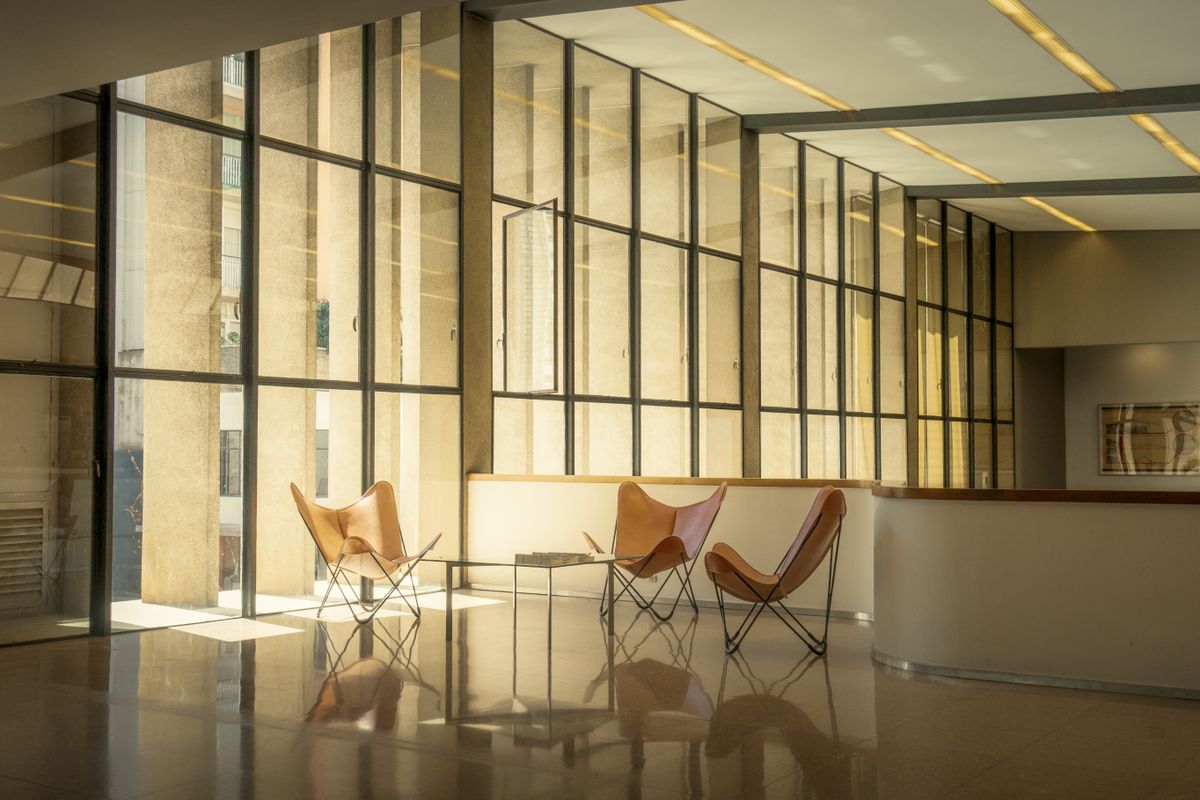
A few quality chairs, natural light, and space to breathe do more for a waiting area than an expensive fit-out. Clients read calm and order as competence.
The 8 Elements of a Modern Law Firm Reception Area
A well-designed reception area has eight components working together. Deficiency in any one of them creates a gap that clients notice even when they can't name it.
1. Seating — your single most important purchase decision. Everything else in reception is secondary to whether the chairs are comfortable, current, and professionally appropriate.
2. Lighting — overhead plus accent. Warm and layered, not flat fluorescent. The second-highest impact element per dollar spent.
3. Firm branding — your name or logo visible from the entrance. A client who walks in and can't identify whose office they're in is immediately uncertain they're in the right place.
4. Reading materials or display — firm-specific materials or professional publications. Not a stack of random magazines donated from the break room.
5. Reception desk or counter — staffed or unstaffed depending on your practice. If unstaffed, clear wayfinding. If staffed, a purpose-built desk, not a repurposed residential table.
6. Plants or art — the humanizing element. One live plant or one quality piece of art makes a reception area feel like a professional environment rather than a waiting room.
7. Technology visible to clients — check-in capability, visible Wi-Fi, current hardware. No equipment that signals "frozen in time."
8. Sound privacy — whether through a white noise machine, background music, or acoustic treatment. Clients in reception should not be able to hear consultations in progress — the law office soundproofing guide covers the fixes from a $60 white noise machine to acoustic panels.
Seating — What Works and What Screams "1998"
Law firms hold onto reception seating far longer than any other furniture. The result is that offices across the country have reception areas with chairs that were installed when the practice opened and have never been replaced. Worn upholstery, flattened cushions, and off-trend colors are among the most consistent signals that a practice isn't attending to details.
What to avoid:
- Stackable plastic chairs — they communicate "budget temporary" regardless of practice area
- Matching plush sets in mauve, burgundy, or hunter green — these colors and silhouettes date a space immediately
- Any chair that becomes uncomfortable after five minutes — clients in legal distress are already anxious; physical discomfort adds a layer of irritation that colors the start of your meeting
- Chairs with fabric that's visibly worn, stained, or pilling
What works:
- Clean-lined upholstered chairs in current neutral colors — navy, charcoal, warm gray, or cognac leather hold up professionally across practice areas
- A side table between chairs — provides a surface for a phone, a glass of water, or a document
- Adequate spacing between seats — clients don't want to sit in physical contact with a stranger who's also there for a legal matter
How many seats: two to three for a solo practice with typically one or two clients waiting at a time. Four to six for firms with multiple attorneys and parallel consultations. Don't underseat — a client who arrives for an appointment and finds no open chair has an experience that begins in discomfort.
ADA consideration: ensure at least one chair without arms, which is easier for clients with mobility limitations. Maintain a clear aisle path to and from the seating area.
Budget: decent upholstered chairs suitable for professional use start at $150–250 each. For a four-seat reception, a $600–1,000 seating investment is appropriate. Below that, the quality signals work against you.
Tip
Lighting for Reception Areas
The most common lighting problem in law office reception areas is reliance on a single layer of overhead fluorescent light. Flat, cool, and harsh, fluorescent overhead lighting is the signature of institutional spaces — waiting rooms, government offices, hospital corridors. These associations work against you in a client-facing professional environment.
The fluorescent overhead problem is fixable without new fixtures in most cases. Warm-tinted LED bulbs in the 2700K–3000K color temperature range replace existing cool-white bulbs directly and change the feel of the space immediately. This is a $20–50 change per fixture and arguably the highest-ROI upgrade available to any law office.
The layered lighting approach that works in reception:
- Warm overhead as the base layer — replaces or supplements fluorescent, creates the ambient temperature of the space
- Floor lamp or table lamp as accent — adds dimension, creates a "designed" feeling rather than a "functional" feeling, and is immediately noticeable to visitors
- Natural light wherever possible — if you have windows in your reception area, treat them as assets. Sheer window treatments that diffuse rather than block natural light are almost always the right choice.
Dimmers: worth installing if your overhead fixture is on its own circuit. The ability to adjust lighting levels — brighter for busy morning hours, warmer for late afternoon consultations — is a small operational luxury that makes a genuine difference in how the space feels across the day.
For rented spaces with fixed fluorescent fixtures: warm-tinted fluorescent tubes are available as a direct replacement for standard cool-white tubes. They're not as warm as LED, but they shift the tone meaningfully for $15–30 per fixture. Add a floor lamp in the corner and the transformation is substantial.
For the full treatment — fixture types, color temperature by room, and video-call lighting — see the dedicated law office lighting guide.
Signage and Firm Branding in the Waiting Space
A client who walks into your reception area should see your firm name within the first few seconds. Not searching for it — immediately seeing it. This is basic wayfinding and basic professional presence, and a surprising number of law offices fail it.
The most professional options:
- Dimensional lettering on wall — individual letters or logo in metal, acrylic, or wood, mounted directly to the wall behind or near reception. Most professional result, $300–1,500 installed depending on size and material.
- Vinyl lettering on glass — clean, modern, cost-effective. Works on partition glass, interior doors, or a glass panel behind reception. $100–400 professionally applied.
- Framed logo print — the entry-level option. A professionally printed and properly framed firm logo on the wall. Not elegant, but far better than nothing. $50–100.
What to avoid:
- No signage at all — clients wonder if they're in the right place, which is a poor start to a trust-building relationship
- Handwritten sign or printed paper taped to the wall — signals amateur operation regardless of your actual competence
- Generic stock art where firm branding should be — the absence of your name is conspicuous when it should be present
Color continuity: your reception area doesn't need to be decorated in your brand colors, but your visible branding should feel at home in the space. A logo in dark navy mounted on a warm gray wall works. The same logo on a background color that clashes with it undermines the professional effect you're trying to create.
Browse the office-inspiration gallery for examples of how different signage approaches look in real law offices at different size and budget levels.
Technology in the Waiting Area
Technology in reception serves two purposes: it improves the client's experience of waiting, and it signals how current your practice operations are. Both matter.
Wi-Fi is essential and should be posted visibly. A client who sits in your reception area for ten minutes without connectivity has ten minutes to feel anxious, impatient, or under-occupied. A client who can check email, send a message, or simply use their phone normally has ten minutes of ordinary time. The Wi-Fi password posted on a small sign near the seating area costs nothing and is consistently one of the small hospitality details clients remember.
Digital check-in: a tablet on a stand at or near reception allows clients to indicate their arrival and complete any remaining intake information before the meeting. This signals a modern, paperless operation and reduces the friction of managing paper forms at reception. Basic check-in apps are available at low cost, and even a simple reception-facing iPad creates a visible signal of operational modernity.
Television (optional): some practices run a muted television in reception. If you do: muted nature or architecture content is neutral. A news channel carries political content risk. Crime-related programming is particularly inappropriate in a legal waiting room — a client waiting for a consultation about a criminal matter doesn't need to watch one unfold on television.
USB charging: a small multi-port USB charging station positioned near one of the reception chairs is a hospitality touch that costs $30 and that clients consistently comment on positively. A client whose phone was at 8% battery when they arrived and is now at 30% when they go into the meeting arrived at that meeting having received an unexpected small service.
Printer visibility: if a printer lives in or near reception, conceal it where possible. Printers with overflowing paper trays, tangled cables, and visible error lights are clutter red flags that undermine an otherwise well-managed reception area.
Small Reception Areas — Maximum Impact in Minimum Space
A small law firm reception area doesn't need to compete with a big-firm lobby — it needs to feel intentional. Many solo attorneys and small firms work with reception areas that are genuinely constrained — a converted corner, a narrow entry, a space that was designed for something else. The constraint is real, and it doesn't require either apology or significant expense to address.
Work with it, not against it. A small, well-designed space reads as intentional. A large, cluttered space reads as neglected. The size itself is not the problem.
Scale your seating to the space. Two excellent chairs beat four mediocre ones in a room that isn't large enough for four. Overcrowding a small reception area makes it feel cramped and overwhelmed. Two quality chairs with a side table and adequate space around them feel curated.
Vertical design. In a constrained floor footprint, vertical elements — a taller plant, wall-mounted art, signage at eye level or above — give the space visual dimension without consuming floor area.
Mirrors can make a small reception area feel meaningfully larger when positioned to reflect light and space. A full-length mirror on one wall or a well-placed framed mirror is an inexpensive visual technique used widely in small professional spaces.
Light. Small spaces suffer disproportionately from poor lighting. A floor lamp in a corner of a small reception area creates warmth and dimension that transforms the feeling of the space. This is where an accent lamp makes the biggest proportional difference per dollar.
The Reception Desk Question
Whether you need a reception desk — and what kind — depends on your practice.
For solo attorneys without a receptionist: an unstaffed reception is common, accepted, and functional. What matters is that clients know what to do when they arrive. Clear signage ("Please have a seat — [Your Name] will be with you shortly") and a check-in tablet handle this effectively. Your office door should ideally be within sight from or adjacent to the reception area so a client who waits the appropriate time can see that someone is present.
For practices with administrative staff: invest in a purpose-built reception desk. Not a residential desk repurposed from a home office. A purpose-built reception desk — with a raised counter on the client side and a lower work surface on the staff side — signals "professional operation" in a way that no residential desk can. This is a meaningful investment, but it's one of the most visible signals in your practice.
Open versus closed reception desk design: an open desk (no barrier between staff and visitors) invites conversation and creates a more approachable atmosphere. A closed desk with a raised counter creates a clear boundary and works well for practices where client volume requires managing the flow of entries. Choose based on your practice area and the client relationship tone you're trying to establish — family law benefits from approachable; high-volume practices may prefer structured.
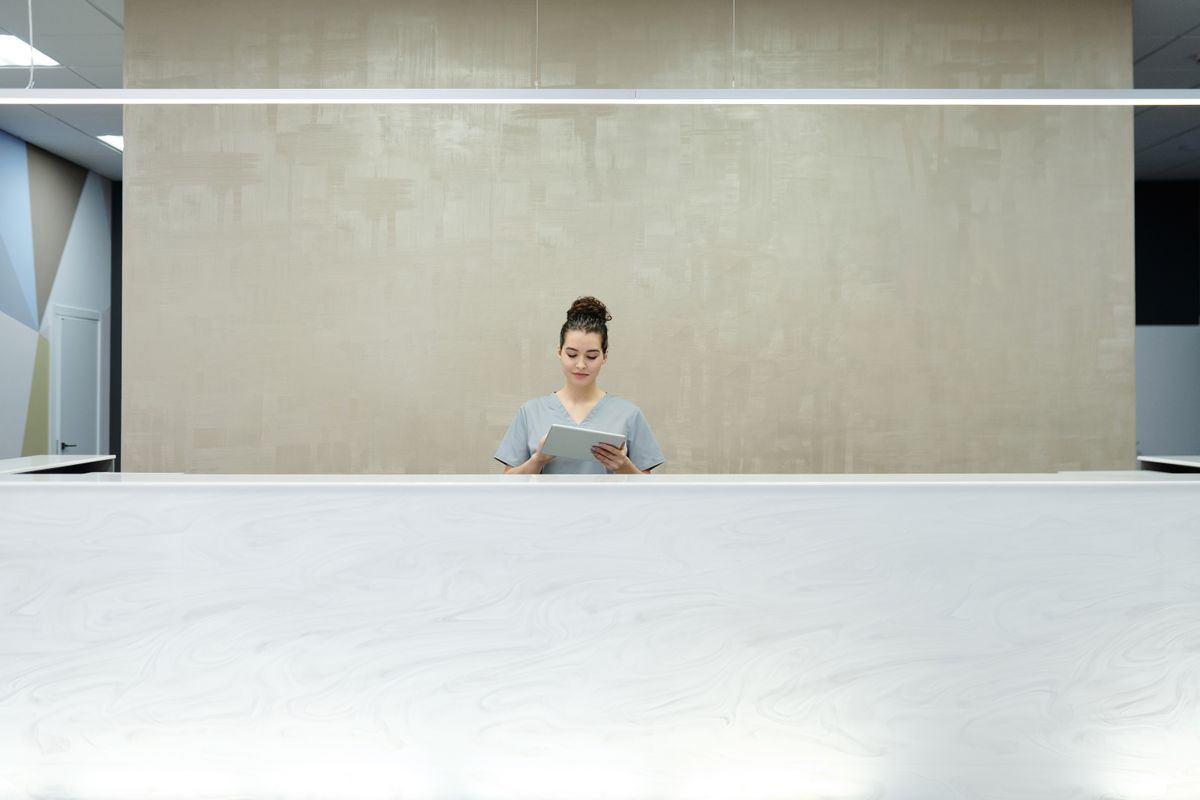
A staffed desk earns its keep when it looks purpose-built and stays clear. A tablet for check-in reads as current; stacked paper reads as chaos.
Reception Area Design Ideas by Style
If you're starting from a blank room, it helps to pick one design direction and commit to it. Mixing styles is how reception areas end up feeling accidental. These three directions each work for a law practice — which one fits depends on your practice area and the clients you serve.
Modern professional. Clean-lined seating in charcoal or navy, a light-toned wood or white desk surface, black or brushed-metal fixtures, and one strong piece of large-format art. Walls in warm white or pale gray. This direction suits business, IP, and estate practices — it signals precision and currency. The risk to manage: too much gray and glass reads cold, so add one warm element (a wood side table, a brass lamp, a live plant).
Warm traditional. Cognac or oxblood leather seating, darker wood tones, warm brass accents, and traditional framed art or maps. This is the classic law office language — it signals establishment and gravity, and it still works, particularly for litigation, criminal defense, and probate practices whose clients often want visible seriousness. The risk: it dates quickly when the pieces are worn. Traditional only works with well-maintained furniture; shabby traditional is the worst-performing look a law office can have.
Calm minimal. Fewer, better pieces: two or three quality chairs, a single plant, one artwork, generous empty space, and layered warm lighting. This direction works especially well for family law, immigration, and any practice whose clients arrive anxious — the space itself lowers the temperature. It's also the most forgiving for small rooms and small budgets, because it needs fewer purchases done well rather than many done adequately.
Across all three directions, the same reception area design ideas keep proving themselves: define the seating zone with a rug, keep every surface clear of operational clutter, put the firm name where it's seen on entry, and layer at least two light sources. Style is a choice; those four are not.
Budget Guide — What Each Price Point Gets You
$500 Reception Upgrade
This budget produces a high-impact transformation without purchasing any furniture.
- Reupholster or update existing chairs with new throw pillows or slipcovers ($100–150)
- Replace fluorescent overhead bulbs with warm LED ($40–60)
- One quality plant in a ceramic or stone pot ($50–80)
- Frame and hang existing credentials in the visible space ($80–100)
- Print and frame firm logo or firm name for the wall ($60–80)
Total investment: under $500. Visible impact: significant. This is the upgrade that most practices should do first, before any furniture purchase.
$2,000 Reception Upgrade
At this level, you're making genuine furniture and fixture changes.
- Two new upholstered chairs and a side table ($600–900)
- Floor lamp for accent lighting ($100–200)
- Professional dimensional signage or quality vinyl lettering ($200–400)
- One piece of professional artwork ($150–300)
- Small area rug to define the seating zone ($100–200)
- White noise machine for sound privacy ($60–80)
Total investment: approximately $1,500–2,000. The result is a near-complete reception upgrade — furniture, lighting, branding, and ambience. This is the price point at which most solo and small firm receptions go from "noticeably dated" to "professionally current."
$10,000 Reception Renovation
At this level, you're building a showroom-quality reception area that becomes a genuine practice differentiator.
- New reception desk (if applicable, custom or semi-custom) — $1,500–4,000
- Full seating set — two to four chairs, side tables, optional small sofa — $2,000–4,000
- Professional lighting installation with fixtures and dimmers — $500–1,500
- Custom dimensional signage in metal or acrylic — $500–1,500
- Professional photography of the completed space — $500–800
- Acoustic treatment or white noise system — $300–500
Total investment: $7,500–12,500. This is a reception area that an attorney puts on their website, includes in their Google Business Profile photos, and uses as a visible signal of a well-run, established practice.
What to Upgrade First — Priority Order
If you're working with limited time and budget, this is the sequence that produces the greatest impact per dollar and per hour:
1. Remove clutter and organize. Cost: $0. Impact: immediate and significant. This is the prerequisite that makes everything else possible. Remove every file stack, every personal item, every piece of office equipment that doesn't belong in the client-facing space. Clean surfaces signal control.
2. Seating. If your chairs are worn, uncomfortable, or visibly dated, this is the first purchase. Every client experiences the seating. It is the single most-used piece of furniture in the room.
3. Lighting. The bulb swap is the highest-ROI change per dollar in the practice. Warm LED bulbs cost $20–50 per fixture and transform the atmosphere of the space. Do this immediately after decluttering.
4. Signage. If your firm name isn't visible when a client walks in, fix this before anything else. This is basic professional presence and basic wayfinding — and it costs $50–400 depending on approach.
5. Art or plant. The humanizing element that no amount of furniture polish can replace. One live plant or one quality piece of art makes a reception area feel like a professional environment — the law office art and decor guide covers what to hang and what to avoid. Do this after the functional priorities.
6. Technology. Wi-Fi posting, digital check-in, and USB charging are the technology priorities once the fundamentals are handled. These are signal upgrades — they tell clients your practice is current — and they cost relatively little.
The office-inspiration gallery at /office-inspiration shows real law offices at each of these budget and upgrade levels. Seeing what's actually achievable — with photos, not descriptions — is the most useful step you can take before spending a dollar.
Frequently Asked Questions
What makes a good law office reception area?+
A good reception area gives a confident, professional first impression within the first few seconds. The core elements are clean and comfortable seating, warm and even lighting, clear firm branding and signage, a tidy and welcoming reception desk, and thoughtful small touches like current reading material, water, and reliable guest Wi-Fi. It should feel calm and considered — the goal is to reassure an anxious client that they've come to the right place, not to look expensive.
How do you design a small law office reception area?+
In a small space, edit ruthlessly and choose a few quality pieces over many cheap ones. A pair of comfortable chairs and a small side table can read as more professional than a cramped row of mismatched seating. Use light colors, good lighting, and a mirror or artwork to open the space up, keep the reception desk compact but real, and remove clutter — an uncluttered small reception reads far better than an overstuffed larger one.
What should a law firm upgrade first in its reception area?+
Start with the elements that most affect a client's first impression for the least money: replace tired or mismatched seating, fix harsh or dim lighting, and clear away clutter and dated magazines. Clean, professional signage and firm branding come next, since they signal legitimacy. Bigger-ticket items like new flooring, a custom reception desk, or a full refit are worth doing once the low-cost, high-impact fixes are in place.
Does the reception area really affect whether clients hire a firm?+
Yes — it forms the first physical impression clients have of your practice, and people form judgments about competence and trustworthiness quickly and largely unconsciously. A dated, cluttered, or uncomfortable waiting area plants doubt before the attorney has said a word, while a calm, professional space reassures a nervous client that the firm is organized and capable. For that reason it's one of the highest-return spaces in the office to get right.
Written by the ModernLawOffice Team under our editorial standards. This guide is practice-management information, not legal advice. Check the rules in your jurisdiction with your state bar. Spotted an error? Tell us.